
Common Heavy Truck Exhaust System Failures and Their Fixes
Need your fleet vehicles better equipped for the job? Get practical truck modifications built around your equipment, crews, and day-to-day operation.
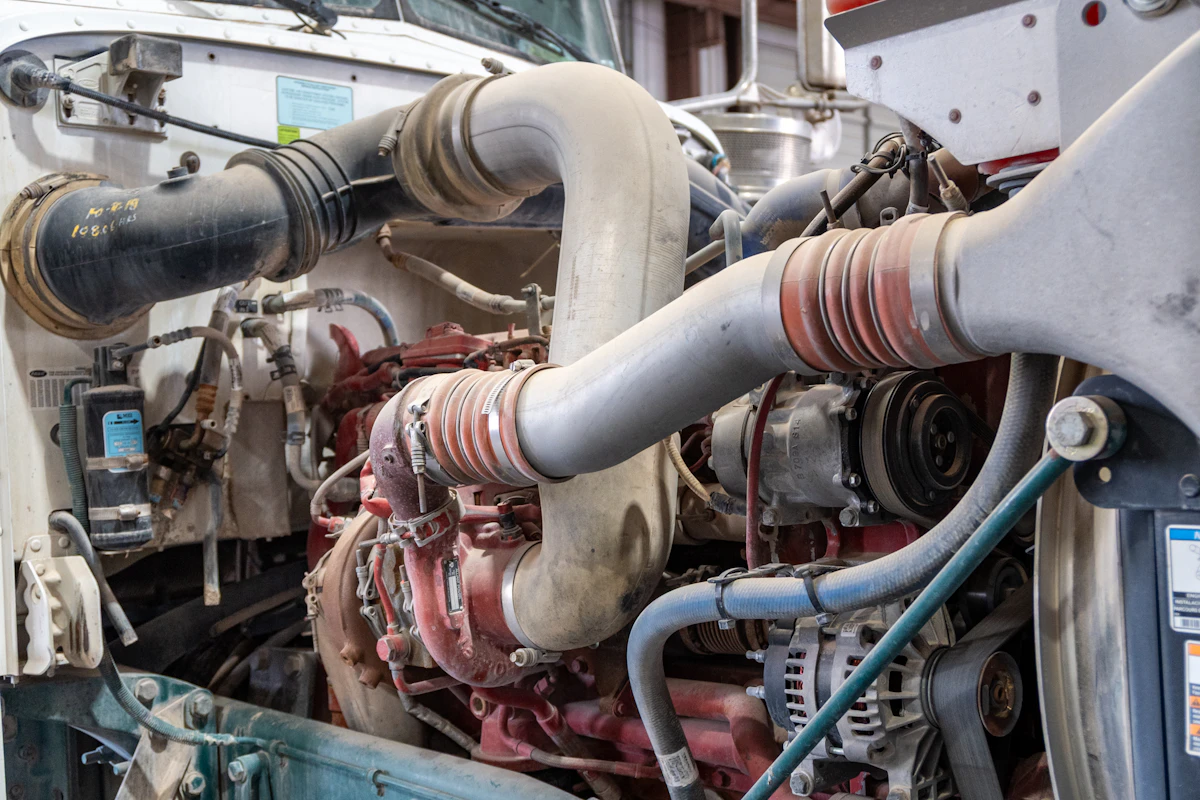
Your truck’s exhaust system does far more than route hot gases out the tailpipe. On a modern diesel truck, it works alongside a sophisticated diesel aftertreatment system that manages emissions before the exhaust reaches the atmosphere.
That sophistication comes with a catch. Soot buildup, faulty sensors, DEF problems, and damaged exhaust components can trigger warning lights, reduce engine performance, or eventually leave your truck unable to operate normally.
Knowing the most common heavy truck exhaust system failures can help you spot trouble early. More importantly, understanding what causes these problems can help you avoid turning a manageable repair into an expensive breakdown.
How a Heavy Truck Exhaust System Works
Combustion produces exhaust gases every time your diesel engine runs. During the exhaust stroke, the piston pushes those gases through the exhaust valve and out of the cylinder.
From there, modern heavy-duty trucks rely on several emissions-control components. Depending on the truck, these can include the EGR system, Diesel Oxidation Catalyst (DOC), diesel particulate filter (DPF), Selective Catalytic Reduction (SCR) catalyst, and Diesel Exhaust Fluid (DEF) system.
Each handles a different part of the emissions-control process.
The EGR system recirculates some exhaust back toward the combustion chamber after cooling it, helping reduce combustion temperatures and nitrogen oxide (NOx) formation. The DPF captures carbon and diesel particulate matter. The SCR system uses DEF to help convert NOx into nitrogen and water vapor.
When one part stops working properly, problems can ripple through the rest of the system.
1. A Clogged Diesel Particulate Filter
A restricted diesel particulate filter (DPF) ranks among the exhaust problems truck operators need to watch closely.
The DPF uses a ceramic-like filtering structure to capture carbon and other particulate matter, preventing them from leaving the truck through the exhaust. Since that material accumulates, the system needs a way to remove it.
That process is called DPF regeneration.
During regeneration, the system raises exhaust temperatures enough to burn away accumulated carbon. Trouble starts when regeneration fails or the filter becomes excessively loaded.
What Causes DPF Problems?
Problems can develop when faulty sensors interfere with regeneration. Operating conditions can also make successful regeneration more difficult, particularly when a truck doesn't achieve the conditions required by its specific aftertreatment system.
Watch your dashboard closely. A DPF or check-engine warning shouldn't become something you simply learn to ignore.
How Is a Clogged DPF Fixed?
The correct repair depends on why the filter became restricted.
A technician should diagnose the aftertreatment system rather than automatically blaming the filter. When sensor problems prevent normal regeneration, repairing the underlying fault may restore proper operation.
In some situations, technicians can perform a forced regeneration, overriding the normal sensor-controlled process to allow the system to burn accumulated carbon. More severe problems may require additional DPF service.
The important part? Find out why the restriction occurred. Otherwise, you may clear the immediate problem only to have it return.
2. EGR System Problems
Your EGR system plays an important role in controlling NOx emissions.
It routes part of the exhaust through an EGR cooler and EGR valve before returning it to the combustion chamber. Introducing cooled exhaust helps lower combustion temperatures, which reduces NOx formation.
When this system develops a fault, emissions performance can suffer.
How Are EGR Problems Repaired?
Diagnosis should focus on the components responsible for controlling and cooling recirculated exhaust. A technician can inspect the EGR valve, EGR cooler, related controls, and other components for faults affecting proper operation.
Don't replace parts based solely on symptoms. Modern diesel emissions systems work together, so proper diagnostics matter.
3. Failed Aftertreatment Sensors
Sensors may be small, but they can create surprisingly big headaches.
The aftertreatment system depends on sensor information to determine what's happening inside the exhaust stream. The handbook specifically notes that faulty DPF sensors can interfere with regeneration.
That's important because a sensor problem can sometimes appear to be a component failure.
You might have an emissions warning or regeneration problem and assume the DPF itself has failed. In reality, the system may not be receiving the information it needs to properly manage regeneration.
The fix starts with heavy-duty truck diagnostics. Reading fault codes and testing the affected system can help determine whether the issue is the filter itself, a sensor, or another aftertreatment component.
4. SCR and DEF System Problems
The SCR system tackles NOx emissions further downstream in the aftertreatment process.
It works with diesel exhaust fluid (DEF), a solution containing 32.5% urea and 67.5% deionized water. DEF is injected into the exhaust stream before gases pass through the SCR catalyst. A chemical reaction then converts NOx into nitrogen and water vapor.
Naturally, problems with this process can interfere with emissions control.
Diagnosing SCR and DEF Faults
Because the SCR process depends on both DEF and the catalyst, technicians need to identify which part of the system isn't operating correctly.
Diagnostic trouble codes provide a starting point, but they're exactly that—a starting point. A proper diagnosis should determine why the fault appeared before components are replaced.
When you see a DEF system warning, schedule diagnostics promptly rather than waiting to see if it clears.
5. Diesel Oxidation Catalyst Problems
The Diesel Oxidation Catalyst, commonly called the DOC, handles another stage of emissions treatment.
Its honeycomb-like structure contains catalyst material that facilitates chemical reactions. The DOC oxidizes carbon monoxide and hydrocarbons in the exhaust, converting them into less harmful substances such as carbon dioxide and water vapor.
Problems affecting the DOC can therefore interfere with the larger diesel emissions system.
Because the DOC operates as part of an interconnected aftertreatment assembly, diagnosis should consider upstream and downstream components rather than treating it as an isolated part.
6. Exhaust Leaks and Damaged Components
Not every exhaust failure involves electronics or emissions chemistry.
Heavy trucks work hard. Heat, vibration, road conditions, and long operating hours can take their toll on physical components. Pipes, joints, clamps, and mounting points can develop problems that allow exhaust gases to escape where they shouldn't.
An unusual exhaust sound deserves attention. So does visible physical damage around exhaust components.
A technician can inspect the system and determine whether damaged components need repair, tightening, or replacement.
Warning Signs You Shouldn't Ignore
Modern trucks often alert you to a problem before a failure becomes severe. Pay attention to symptoms such as:
- Check-engine or emissions warning lights
- DPF warnings
- DEF or SCR warnings
- Regeneration problems
- Changes in engine performance
- Unusual exhaust sounds
- Recurring aftertreatment fault codes
One warning doesn't automatically tell you which component failed. That's why diesel exhaust diagnostics are so important.
The goal isn't to guess. It's to identify the actual cause.
Preventing Heavy Truck Exhaust System Problems
You can't prevent every failure, but preventive maintenance gives you a much better shot at catching developing problems early.
Start by following the truck and engine manufacturer's maintenance requirements. Pay attention to warning lights instead of clearing codes and continuing down the road. When an emissions fault keeps returning, have the cause diagnosed.
Most importantly, look at the system as a whole.
The EGR, DOC, DPF, SCR, DEF equipment, sensors, and engine controls don't operate in isolation. A fault affecting one area can influence another. Accurate diagnostics can therefore save considerable time compared with replacing components until the warning light finally disappears.
Keep Your Truck's Exhaust System Working Properly
Modern heavy truck exhaust systems combine filtration, chemical reactions, sensors, and engine controls to manage diesel emissions. Common trouble spots include DPF restrictions, regeneration failures, EGR faults, sensor problems, SCR and DEF issues, DOC concerns, and physical exhaust damage.
Catch those problems early and get the underlying cause diagnosed. That's the best way to protect your truck from repeat faults and unnecessary downtime.
If you're dealing with exhaust or aftertreatment problems in El Paso, contact Duran and Sons Towing to discuss your truck's symptoms and determine the appropriate next step.
.webp)
.webp)

Contact Us
Get in touch with Duran & Sons Diesel today to schedule your truck or fleet in for professional repairs.
Hours: Monday to Friday, 8am - 5pm
Shop Address: 14300 Peyton Rd, El Paso, TX 79928